
PNLF-BINGO: Binary INteractions as the Gateway to understanding the Origin of the Planetary Nebula Luminosity Function cut-off

Planetary nebulae (PNe) are traditionally regarded as the final evolutionary stage of low- and intermediate-mass stars. However, growing observational evidence suggests that single-star 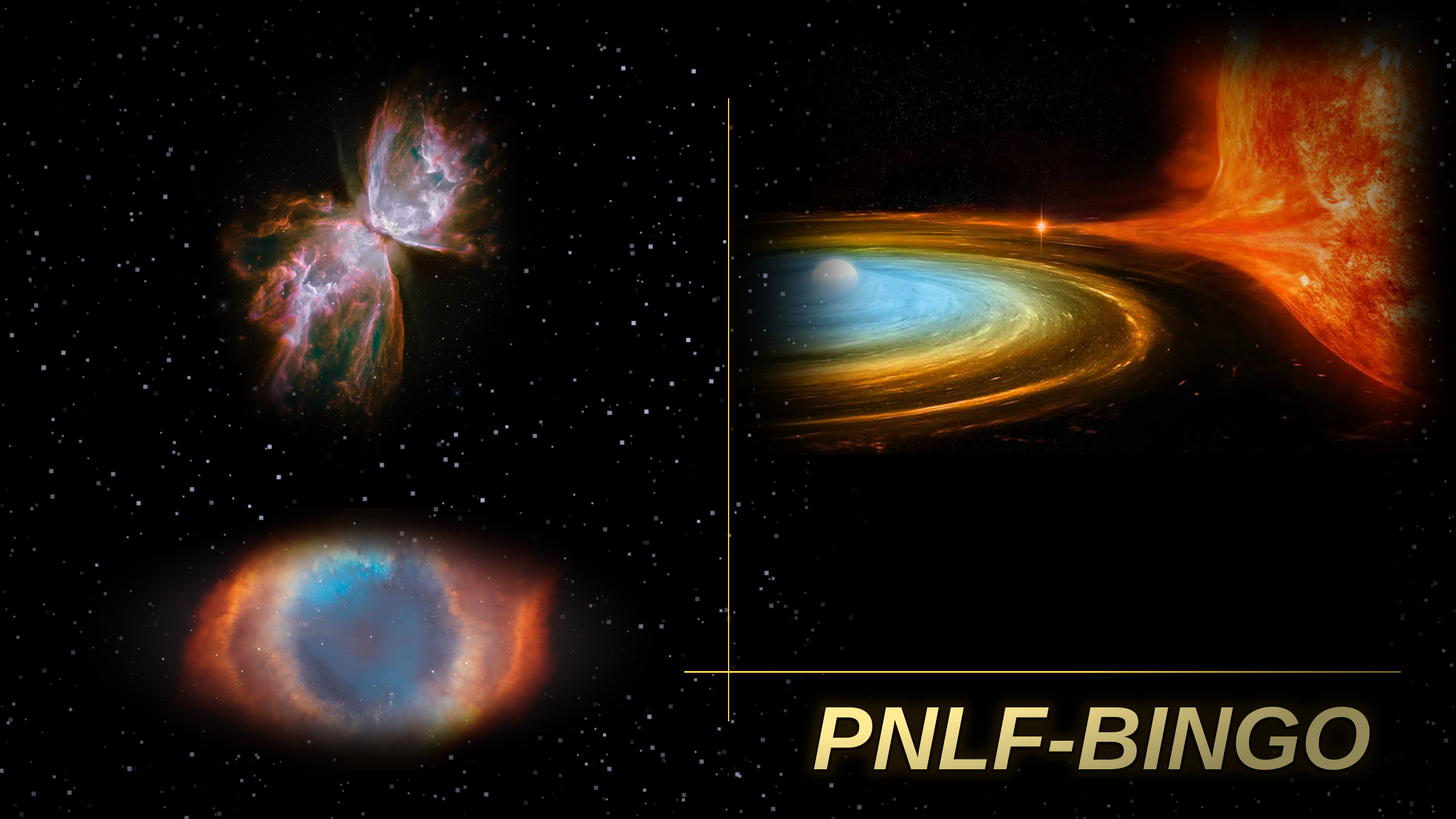 evolution alone cannot explain the diverse morphologies and physical properties of most PNe, highlighting the importance of binary interactions in shaping their formation and evolution. Beyond their significance for stellar evolution, PNe serve as valuable extragalactic distance indicators, enabling distance measurements out to approximately 40 Mpc. In particular, the brightest PNe exhibit a remarkably uniform maximum luminosity in the [O III] (\lambda5007) emission line across different galaxy types, defining the bright-end cut-off of the planetary nebula luminosity function (PNLF). Despite its widespread use as a distance indicator, the physical mechanisms underlying this luminosity uniformity remain poorly understood. Given the high binary fraction among low- and intermediate-mass stars, together with increasing evidence for binary interactions in the central stars of PNe, several evolutionary channels have been proposed to explain the bright-end cut-off of the PNLF. These include blue stragglers, accreting white dwarfs (WDs), symbiotic binaries, and common-envelope (CE) evolution. Nevertheless, the relative contributions of these channels and their respective roles in explaining the invariance of the PNLF bright-end cut-off remain uncertain.
PNLF-BINGO is an HFRI-funded project, led by Dr. Dimitris Souropanis, that aims to investigate the full range of evolutionary pathways leading to PNe within a comprehensive binary population synthesis framework. The project combines POSYDON, a state-of-the-art binary population synthesis code built on detailed binary stellar evolution models computed with MESA, with the CLOUDY photoionization code. This integrated approach will enable us to predict the formation rates and ionizing properties of PN central stars, as well as the emission properties of their surrounding nebulae, across realistic stellar populations in which binary interactions play a central role. By systematically evaluating the contributions of different evolutionary channels, PNLF-BINGO aims to clarify how binarity shapes both the overall PN population and the PNLF, ultimately constraining the physical mechanisms responsible for the invariance of its bright-end cut-off. Beyond this, the project will advance our understanding of binary evolution of low and intermediate stars, interacting binaries within PNe, and shed light to Type Ia supernovae, where a fraction of them occur in and interact with PNe.