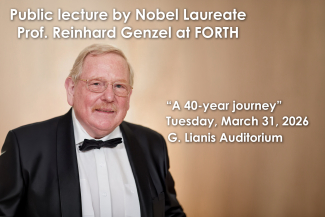
Public lecture by Nobel Laureate Prof. Reinhard Genzel at FORTH
On Tuesday, March 31, 2026, the 2020 Nobel Laureate in Physics, Professor Reinhard Genzel, will deliver an open lecture for the broader scientific community at 14:00, at the G. Lianis Auditorium of the Foundation for Research and Technology–Hellas (FORTH) in Heraklion. The lecture is organized by the Institute of Astrophysics of FORTH and the Department of Physics of the University of Crete.
Professor Reinhard Genzel is Director of the Max Planck Institute for Extraterrestrial Physics in Garching, Germany; Professor at the Graduate School of Physics and Astronomy at the University of California, Berkeley, USA; and Honorary Professor of Physics at Ludwig Maximilian University of Munich. He was awarded the 2020 Nobel Prize in Physics “for the discovery of a supermassive compact object at the center of our galaxy.”
Prof. Reinhard’s Lecture at FORTH – A 40-year journey
More than one hundred years ago, Albert Einstein published his Theory of General Relativity (GR). One year later, Karl Schwarzschild solved the GR equations for a non-rotating, spherical mass distribution; if this mass is sufficiently compact, even light cannot escape from within the so-called event horizon, and there is a mass singularity at the center. The theoretical concept of a 'black hole' was born, and was refined in the next decades by work of Penrose, Wheeler, Kerr, Hawking and many others. Therefore, a black hole is a supermassive compact object with a gravitational force so large that nothing, not even light, can escape from it. Since nothing, not even light, can escape black holes, they can only be observed by the radiation and the movement of nearby objects. First indirect evidence for the existence of such black holes in our Universe came from observations of compact X-ray binaries and distant luminous quasars.
Since the 1990s, Reinhard Genzel and Andrea Ghez with their respective research teams, have developed and refined techniques for studying the movement of stars. Prof. Reinhard will present the forty-year journey, which he has been undertaking with his colleagues to study the mass distribution in the Center of our Milky Way from ever more precise, long term studies of the motions of gas and stars as test particles of the space time. Observations of stars in the area around Sagittarius A* in the middle of our galaxy, the Milky Way, revealed the existence of a four million solar mass object, which must be a single massive black hole, beyond any reasonable doubt.