
Skinakas Space Telecom & Surveillance Upgrade
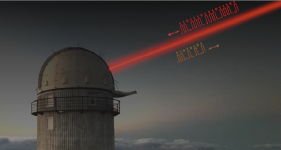
Improvements in space technology and lowering costs for launches by private companies (ie SpaceX) has led to a dramatic increase of the satellites sent into space. According to the Union of Concerned Scientists’ satellite database, up to the end of 2022 there were 6,718 functioning satellites in Earth orbit of which 5,938 were in Low Earth Orbit (LEO) and over 80% of those were launched in just the past 3 years. There are proposals for an estimated 250,000 satellites to be launched into LEO over the next decade. This represents about a 40-fold increase over the current number.
Even though the large number of satellites will likely affect ground based astronomical observations, a need to transfer to the ground the huge amount data they collect, as well as to track their exact location presents new opportunities and usage for optical telescopes and astronomical observatories. The reasons are fairly simple: to transfer the data laser beams in the near-infrared present a 100,000 fold increase in the bandwidth compared to downlink with radio waves along with improved security, using quantum encryption and having smaller footprint of the beam on the ground. Moreover, obtaining the exact location of the satellites requires imaging them in the optical, as moving targets, again using telescopes.
Skinakas observatory, using funding from ESA and the EC has commenced a major upgrade of its infrastructures in order to play substantive role in this new emerging field of ground-to-space secure laser telecommunications as well as space traffic management, thus opening opportunities for private and public actors in Greece. Additional support from the Region of Crete and the Municipality of Anogeia is providing long needed upgrades to the road reaching the observatory as well as electric power needs by connecting the observatory, currently powered by photovoltaics and generators, to the electric grid of the island of Crete.
Links to the relevant projects follow:
HellasQCI: The HellasQCI project - start date January 2023 - aims to deploy advanced national Quantum Communication Initiative (QCI) systems and
 networks in Greece. The project, in which the Distributed Computing Systems and Cybersecurity Lab of ICS/FORTH and the Theoretical Quantum Optics and Technology Lab of IESL/FORTH are also involved, will result in having Skinakas Observatory connected with the optical fiber network of Crete and obtain the necessary infrastructure for secure communication using Quantum key distribution (QKD). The advancement in technologies that will be achieved by the realisation of the HellasQCI initiative include:
reinforcement of Scientific and Technological capabilities in cybersecurity,
improvement of industrial competitiveness,
strengthening European digital sovereignty
TransEuroOGS: The mission of TransEuroOGS - start date January 2026 - is to build a fully interoperable and orchestrated QKD network of eight optical ground stations spanning over four Member States for linkage to the EuroQCI space segment and demonstrating first services in cross-border interoperability with dedicated interconnections to the EuroQCI terrestrial backbone is a strategic project that aims to create a cross-border quantum communications network. The objectives of the project are:
- Equal Member State representation in the development and activities of the OGS networ
- General OGS enablement in classical interfaces to the Eagle-1 Mission and local fibre networks of OGS sites in connecting the space and terrestrial segment of EuroQCI
- OGS enablement for Eagle-1 with a quantum receiver module for QKD services of the OGS
- Generalized KMS architecture in open-source and SDN abstraction layer for interoperability across all Member States in the key relay mechanism of OGS sites to local fibre networks
- Validation and certification protocol as a baseline for SES inspection and interoperability of all OGS in preparation of demonstrations to cross-border QKD services.
- Use Case Development and Demonstration of OGS interoperability
- Comprehensive Study of the OGS Network
SEEWQCI: The South-East and Western Europe Quantum Communication Infrastructure (SEEWQCI) - start date January 2026 - is a strategic project that aims to create a cross-border quantum communications network
 between Greece, Cyprus, Bulgaria and the Netherlands. The objectives of the project are:
- Develop the SEE Terrestrial QKD corridor
- Establish Satellite connectivity linking SEE & WE
- SEEWQCI KMS and network orchestration
- SEEWQCI Demonstrations
- Cooperation with EuroQCI stakeholders
- Alignment with EuroQCI and the EU-QCI requirements and standardization efforts
SkinUp and SkinOperations: The project, which is performed in close collaboration with the members of the Space Optics lab of IESL/FORTH, started in May 2023 and has as objectives:
Establishment of the critical operational parameters for classical space optical communication to operate on the 1.3 m telescope of Skinakas Observatory in Crete, Greece. Design of the OGS terminal. Design of a fast-reacting active optics module to compensate for beam wobbling due to turbulence.
Development of active optical stabilisation including lasers and electronics, tested in the laboratory and installed on the telescope of Skinakas Observatory.
Demonstration of optical communication with a satellite in LEO orbit.
Preparation of a quantum channel interface for future use.
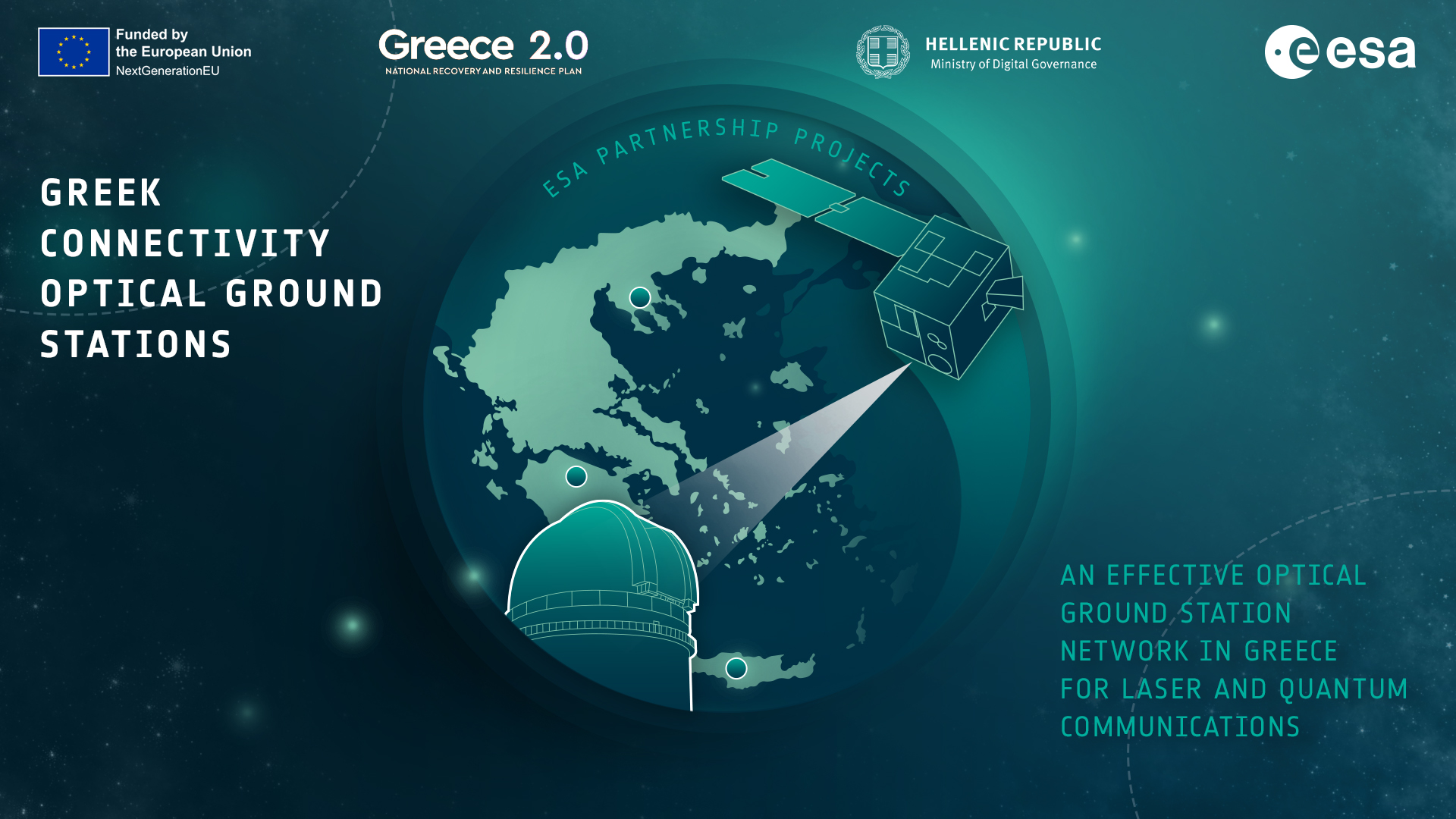
Greek Connectivity Optical Ground Stations: The project, which is led by Raymetrics, started in January 2024 and has as objective to develop a uniform central control systems for the three Optical Ground Stations (OGS: Chelmos, Cholomontas and Skinakas) in order to perform:
Open loop tracking of satellites in any orbit.
Closed loop precision tracking of satellites and establishing bidirectional optical links.
Reception of optical communication and quantum signals and their coupling into individual single mode fibres.
Transmission of a beacon or communication signal towards satellites.
Object detection in the telescope field-of-view (FoV), such that automatic transmit beam cut-off is triggered to ensure laser safety.
Preparation for the execution of all functions autonomously (without human intervention).