
A black hole jet caught twisting its magnetic field in just over an hour
At the centres of many galaxies sit supermassive black holes, millions to billions of times the mass of our Sun. Some of them launch enormous jets of hot, magnetized gas into space at nearly the speed of light. When one of these jets happens to point almost straight at Earth, astronomers call the object a blazar. Blazars are among the brightest and most changeable objects in the Universe, but they are hard to understand. Because we look straight down the jet, its speed distorts what we see. This makes it difficult to work out what is actually happening inside the jet.

Figure 1. Artist’s impression of a blazar: a supermassive black hole at the centre of a galaxy, surrounded by a disc of hot gas, launching a jet of plasma pointed towards Earth.
One way astronomers study these jets is through polarization. Light from a blazar’s jet doesn’t vibrate in random directions. It tends to line up along a preferred direction, and that direction follows the jet’s magnetic field. By measuring it, astronomers can track how the field changes over time. For decades they have seen a striking behaviour: the direction of polarization sometimes turns smoothly by large angles, a sign that the jet’s magnetic field is changing in an organized way. These rotations usually unfold over several days, and what causes them has long been debated.
Observations with the RoboPol instrument at the Skinakas Observatory in Crete hinted that some rotations might happen much faster, within a single night. Checking once every few days could simply be missing them. Until now, however, no one had ever caught one. To search for them, astronomers at the Institute of Astrophysics began following blazars continuously throughout the night.
On the night of 3–4 May 2024, researchers from the Black Hole Optical Polarization Time-Domain Survey (BOOTES) project were watching the blazar PKS 1510-089. Its light set out roughly four billion years ago. During the night, its polarization direction swung by about 136° in only about 80 minutes. That is nearly ten times faster than any rotation seen before.
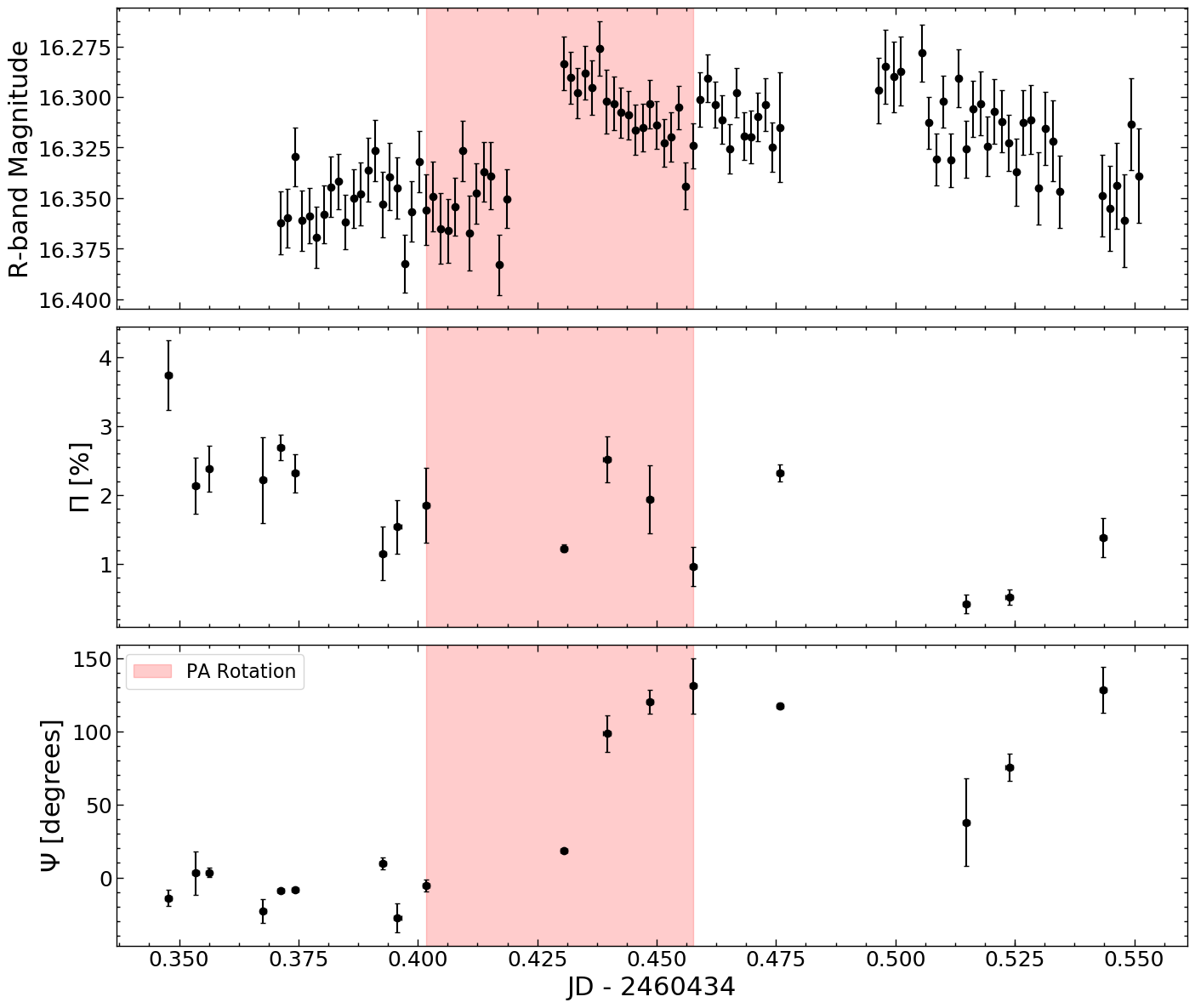
Figure 2. Observations of PKS 1510-089 during the night of 3–4 May 2024 with RoboPol at Skinakas. The top panel shows the brightness of the blazar, the middle panel shows how strongly its light is polarized, and the bottom panel shows the direction of polarization. The shaded area marks the rotation of about 136° in roughly 80 minutes. From Polychronakis et al., Fig. 1.
To find the cause, the team turned to radio images of the jet taken with the Very Long Baseline Array, a network of radio telescopes spanning the United States. These images revealed a new bright “blob” of gas travelling out along the jet. It broke away from the jet’s base just around the time of the rotation. The blob is most likely a shock wave, similar to a sonic boom, travelling down the jet. As it crossed the turbulent region at the jet’s base, it twisted the magnetic field. The other proposed explanations did not match what the team saw, such as magnetic field lines snapping and reconnecting, or the jet becoming unstable and kinking.
The team also compared the event with a similar rotation seen in another blazar, 3C 454.3, which took about twelve hours. Once the different distances and the speed-of-light effects in the two jets are accounted for, the two events look almost identical. This suggests that the same mechanism drives both: shocks moving through the jet. In the case of PKS 1510-089, the jet’s extreme speed squeezed the event into just over an hour as seen from Earth. Catching more of these events, by watching blazars through the night and combining the data with radio images, will help reveal how these cosmic jets work.
The IA-FORTH team includes Aris Polychronakis, Ioannis Liodakis, Dmitry Blinov, Anastasia Glykopoulou and Sebastian Kiehlmann. The observations were carried out as part of the ERC-funded BOOTES project.