
NASA's Hubble Space Telescope captures first-ever images of asteroid collisions around nearby star
|
Announcement Date :
|
Astronomers using NASA's Hubble Space Telescope have captured the first direct images of catastrophic asteroid collisions in another planetary system — a discovery that provides unique insight into how planets form and evolve.The new data comes from observations of the nearby star Fomalhaut, located 25 light-years from Earth. The study was recently published in the prestigious journal Science.
Fomalhaut is one of the brightest stars in the night sky. Located in the constellation Piscis Austrinus, also known as the Southern Fish, it is more massive and brighter than the Sun and has been of interest to scientists for years because of the bright dust rings surrounding it.
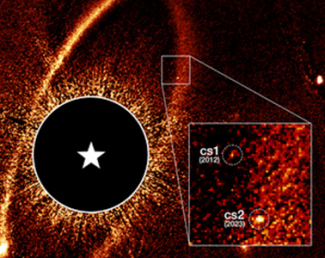
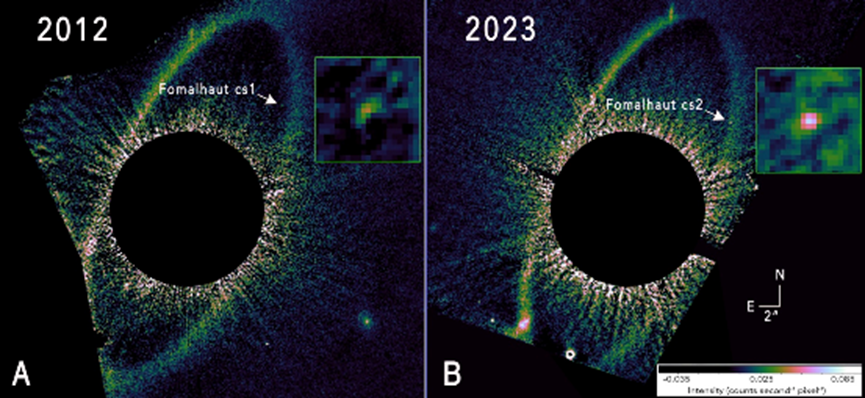
In 2008, the possible detection of an exoplanet "Fomalhaut b" was reported, which now appears to be a dust cloud resulting from a collision of planetesimals and resembling a planet, now called Fomalhaut cs1 (circumstellar source 1).
New Hubble images have revealed a second bright spot in the same area, Fomalhaut cs2, which is also interpreted as a cloud of debris from the collision of two large bodies.
"This is certainly the first time I've ever seen a point of light appear out of nowhere in an exoplanetary system," said principal investigator Paul Kalas, professor in the Department of Astronomy, Univ. of California, Berkeley, and a Fellow researcher at the Institute of Astrophysics of the Foundation for Research and Technology - Hellas. "It is absent in all of our previous Hubble images, which means that we have just witnessed a violent collision between two massive objects and a huge debris cloud, unlike anything in our own solar system today. Amazing!"
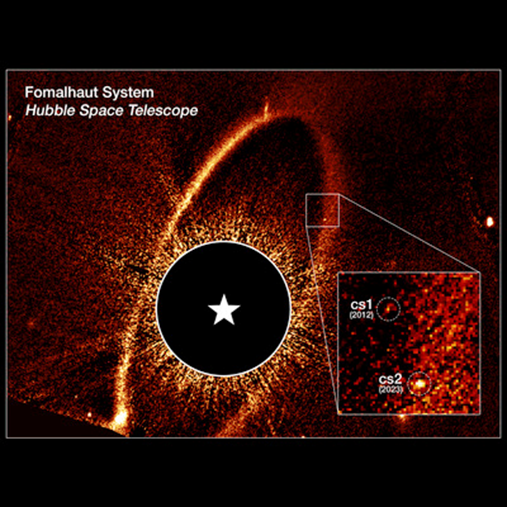
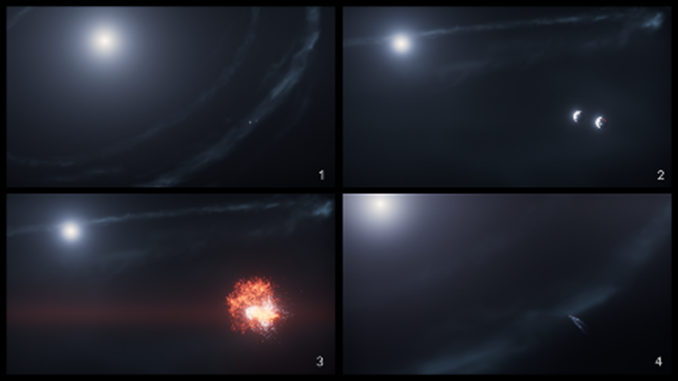
The fact that two such rare phenomena were detected in the same place within just two decades is a significant scientific mystery. If the collisions between asteroids and planetesimals were random, cs1 and cs2 should appear by chance at unrelated locations. Yet, they are positioned intriguingly near each other along the inner portion of Fomalhaut’s outer debris disk. “Previous theory suggested that should be one collision every 100,000 years or longer. Here, in 20 years, we have seen two,” explained Kalas.
The observations allow researchers to estimate the size of the objects that collided, as well as how many similar bodies are orbiting in the system, information which is almost impossible to get by any other means. "Our estimates put the planetesimals that were destroyed to create cs1 and cs2 at just 30 kilometers in size, and we infer that there are 300 million such objects orbiting in the Fomalhaut system" says Prof. Mark Wyatt (University of Cambridge).
The transient nature of Fomalhaut cs1 and cs2 poses challenges for future space missions aiming to directly image exoplanets. Such telescopes may mistake dust clouds like cs1 and cs2 for actual planets.
“Fomalhaut cs2 looks exactly like an extrasolar planet reflecting starlight,” said Kalas. “What we learned from studying cs1 is that a large dust cloud can masquerade as a planet for many years. This is a cautionary note for future missions that aim to detect extrasolar planets in reflected light."
Astronomers have secured additional observation time with Hubble to monitor the evolution of cs2 over the next three years, and observations will also be made with the James Webb Space Telescope to study the composition and size of the dust grains. It will also be possible to investigate the possible existence of water ice at the cloud.
Link to the publication: P. Kalas et al., Science 10.1126/science.adu6266 (2025)
https://www.science.org/doi/10.1126/science.adu6266
Fomalhaut cs2 Videos:
https://www.youtube.com/watch?v=LJw8tqM2b4g (Credit: NASA, ESA, Ralf Crawford (STScI)
https://youtu.be/8fJRP8AQZzQ (Credit: P. Kalas)
The Astrophysicist Paul Kalas
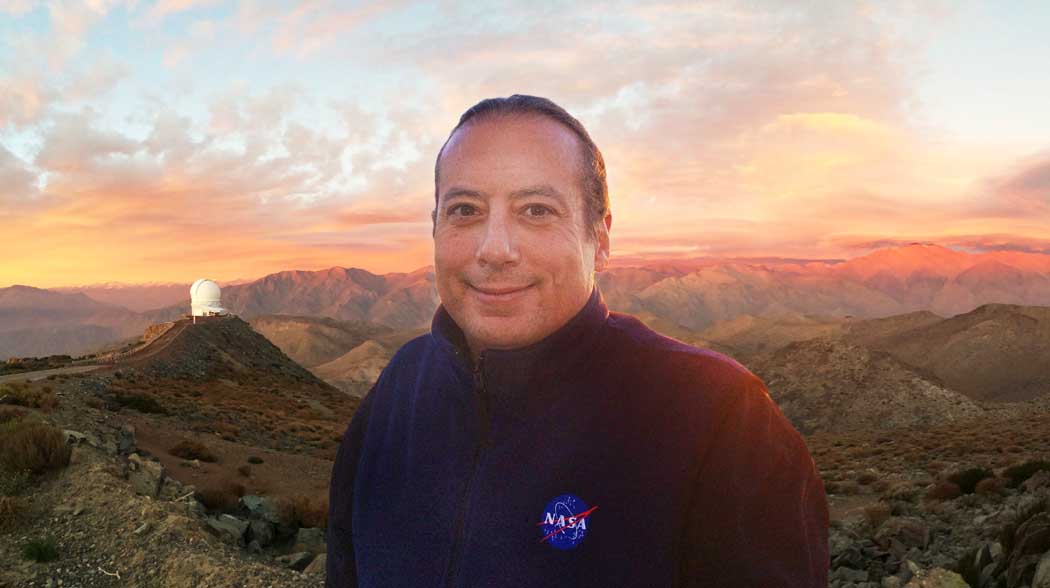
Paul Kalas is a professor at the University of California, Berkeley, and since 2019 he has been a Research Fellow at the Institute of Astrophysics of FORTH. His dual role directly enhances IA-FORTH's international presence in leading astronomical discoveries.
More information about him can be found at the following link: https://www.ia.forth.gr/people/Kalas