
How star formation and AGN shape dust and gas across nearby luminous infrared galaxies
Intense star formation and active black holes can affect the material between stars far beyond galaxy centres. Research led by Cristina Lofaro reveals how the charge state and size distribution of small dust grains, the efficiency of gas heating, and the excitation of interstellar gas vary across nearby luminous infrared galaxies. The work was carried out as part of Lofaro’s doctoral research at the University of Crete and the Institute of Astrophysics of FORTH (IA-FORTH), under the supervision of Dr. Tanio Díaz Santos. Presented in two companion papers, the study combines infrared observations from NASA’s Spitzer Space Telescope and ESA’s Herschel Space Observatory for 67 nearby galaxies from the Great Observatories All-sky LIRG Survey (GOALS), tracing their interstellar medium to projected distances of approximately 14 kiloparsecs from their centres. Small carbon-rich dust grains known as polycyclic aromatic hydrocarbons (PAHs) absorb ultraviolet radiation and can heat the surrounding gas by ejecting electrons. Lofaro and her collaborators found systematic changes in these grains across galaxies dominated by star formation. PAHs become progressively more neutral out to approximately 8 kiloparsecs, while smaller grains contribute increasingly beyond about 5 kiloparsecs. Farther out, the charge trend reverses toward more ionized PAHs. These patterns are consistent with the preferential destruction of smaller grains in the intense radiation fields near central starbursts.
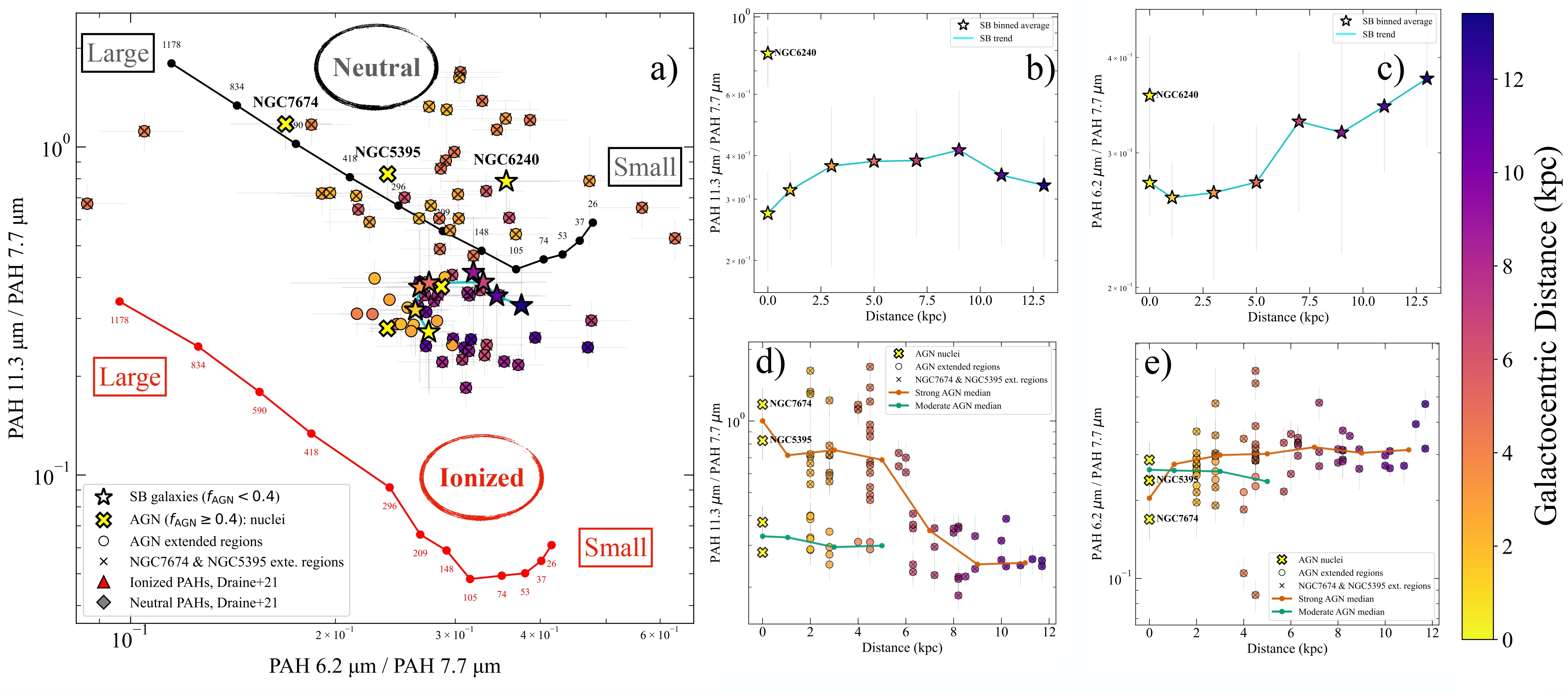
The dust measurements also connect directly to the thermal balance of the gas. A proxy for photoelectric heating efficiency increases with distance from galaxy centres in both starburst and active-galaxy environments. In starbursts, this increase follows changes in PAH charge more closely than changes in grain size, consistent with more efficient gas heating as the radiation field weakens outward. The companion analysis of infrared gas-emission lines provides a complementary view of these environments. By comparing the observations with CLOUDY photoionization models, Lofaro and her collaborators showed that combining mid- and far-infrared measurements is essential for interpreting the radial ionization structure. In starburst galaxies, the combined diagnostics indicate a decreasing ionization parameter with distance from the centre, whereas mid-infrared measurements alone yield the opposite trend. The far-infrared [C II] emission associated with neutral gas supplies a critical constraint.
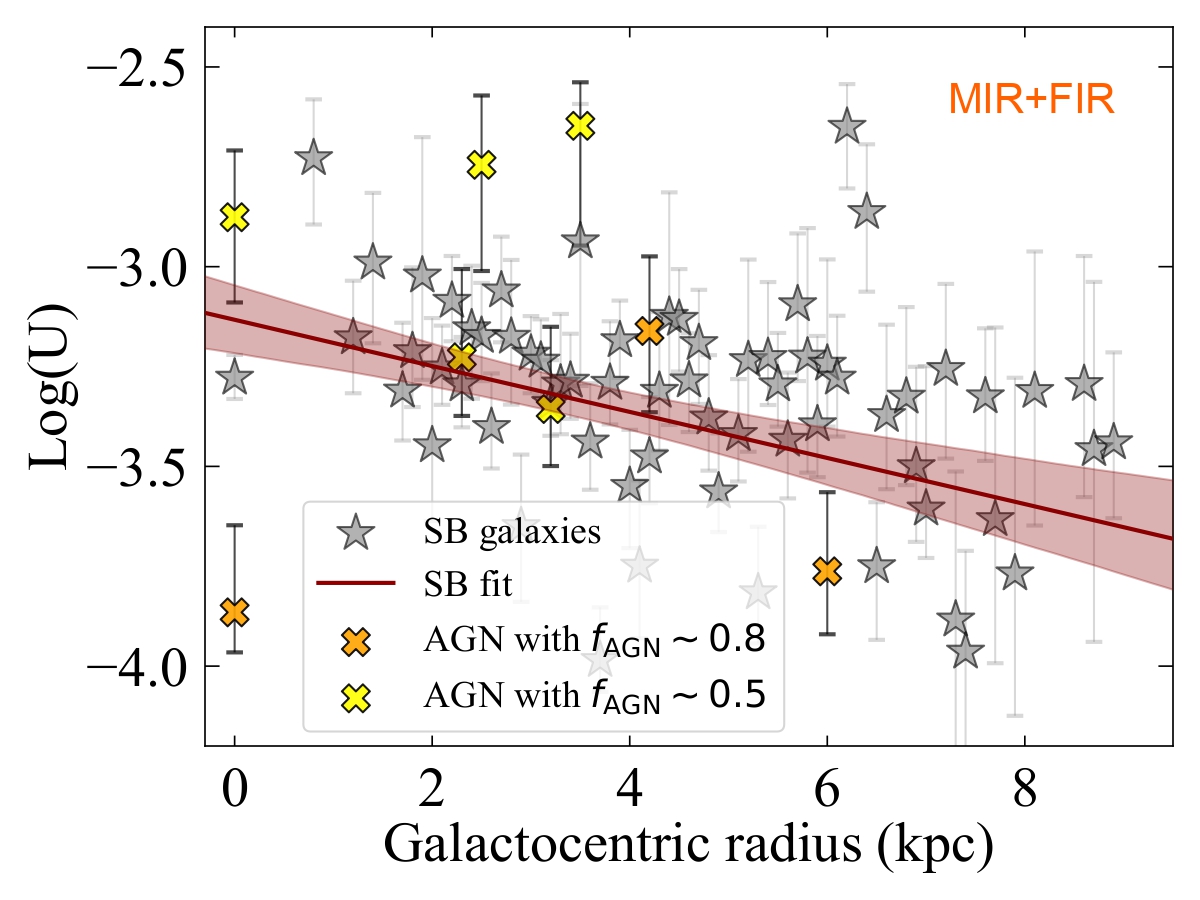
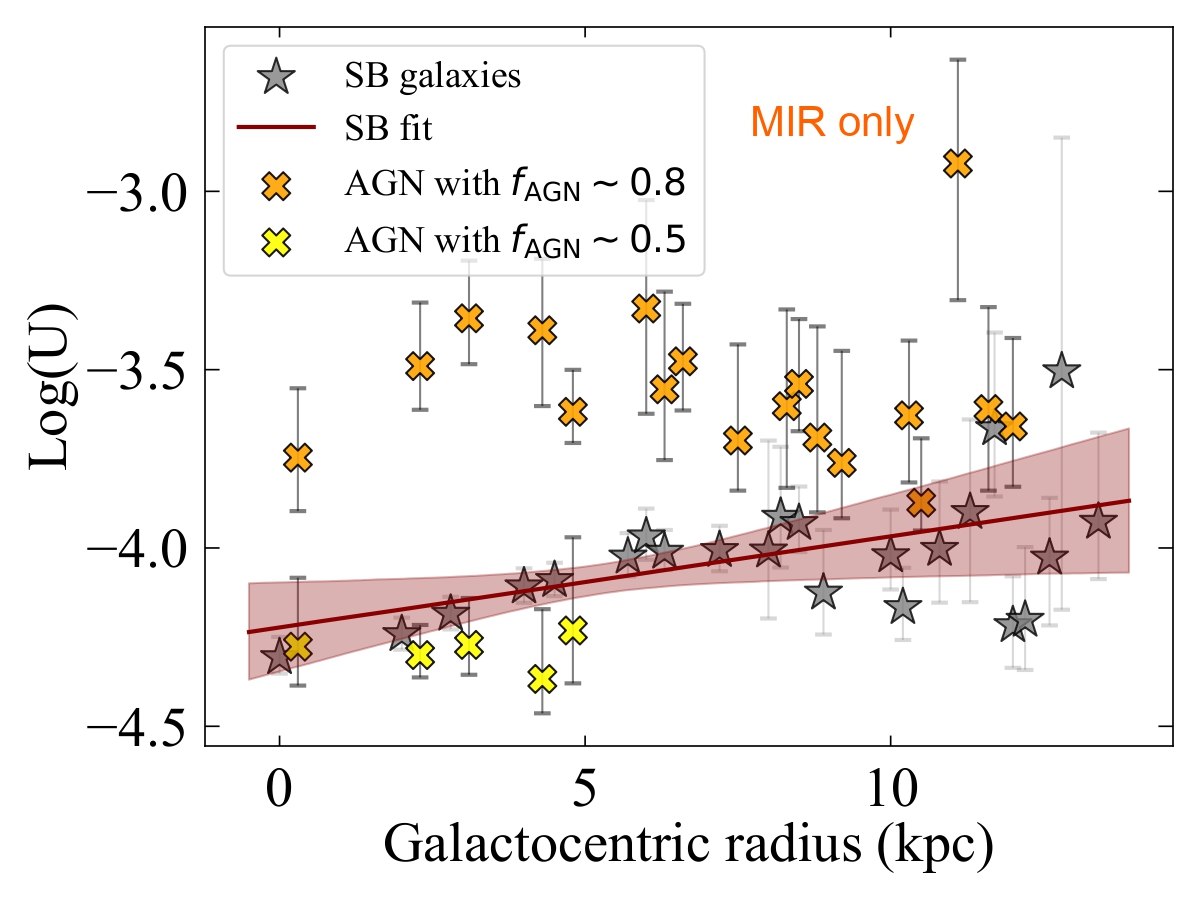
Together, the dust and gas diagnostics also suggest that strong active nuclei can influence their surroundings over several kiloparsecs. Distinctive PAH signatures persist to approximately 5 kiloparsecs in the strongest active-galaxy hosts. In NGC 7674, gas excitation likewise retains an active-nucleus signature over similar distances, while the outermost region resembles star-forming gas. These findings remain tentative because relatively few strong active nuclei have suitable spatially resolved measurements. For the modelling, Lofaro and her collaborators developed SINEFIA, a Python tool that generates CLOUDY model grids and compares them with observed emission lines within a Bayesian framework. The two studies bring dust processing, gas heating and gas excitation into a common picture of the extended interstellar medium. They provide the wider spatial context needed to interpret detailed observations of dusty galaxies with JWST and ALMA.
Articles
• Lofaro et al., “Resolving the extended interstellar medium of infrared galaxies I. Polycyclic aromatic hydrocarbon emission”, Astronomy & Astrophysics, 712, A84 (2026).
• Lofaro et al., “Resolving the extended interstellar medium of infrared galaxies II. Fine-structure line emission”, accepted for publication in Astronomy & Astrophysics.